

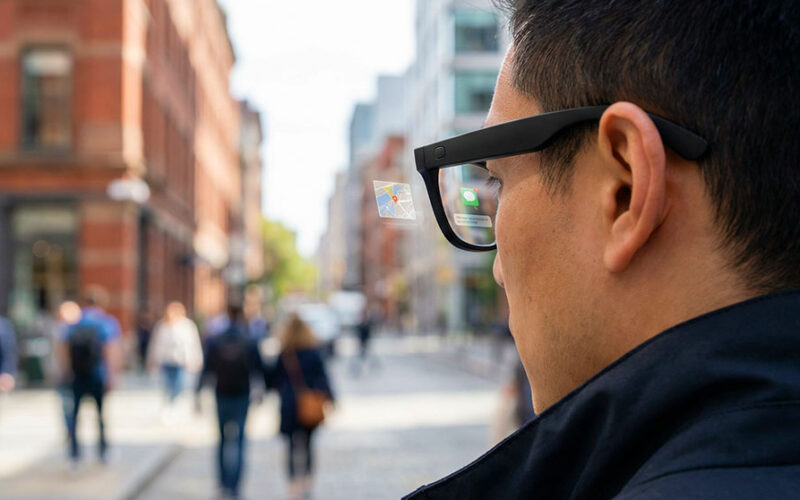
There’s a new favourite accessory in the tech world. AI smart glasses are now officially in their “momentum phase.” Move over, VR headsets.
Global exports of AI-powered glasses surged by 322% in 2025, reaching an astounding 8.7 million units, according to the most recent figures from market research firm Omdia. Once dismissed as a niche experiment, this technology has blossomed into a booming consumer market. Analysts anticipate that shipments will exceed 15 million units by 2026.
China is quickly closing the gap with Meta, currently the market leader. The surge in popularity can be largely attributed to the success of the Ray-Ban Meta collaboration. Meta has skilfully reshaped the perception of these devices, moving away from the “socially awkward” image of earlier attempts, such as Google Glass, by blending high-fashion aesthetics with advanced technology.
Meta’s Dominance: With 7.4 million units shipped, Meta commands nearly 85% of the global market. Their position as the industry leader has been solidified by their expansion into Brazil, Mexico, and India.
The China Factor: Mainland China is the fastest-growing market, claiming 10.9% of the total. Local companies like Xiaomi and Rokid are actively launching “display-equipped” glasses that project information directly into the user’s line of sight, currently holding a 71% market share.
Why the sudden excitement?
Multimodal AI is the key to it all. These days, smart glasses are more than just “frames with speakers.” These “seeing” glasses enable users to:
Real-time translation allows you to quickly read foreign signage or menus.
Recognize Landmarks: Just by looking at a building, you can learn its history or directions.
Produce Hands-Free Content: They have become a “must-have” for digital creators due to their ability to record 3K video and transmit straight to social media.
“According to Mark N. Vena of SmartTech Research, the category has finally evolved from a research project to something that consumers can genuinely envision wearing in public.
The Room’s Privacy Elephant
Concerns increase along with shipments. Smart glasses, in contrast to smartphones, are subtle, creating a “data pipeline” that many customers find alarming.
72% of US internet households are concerned about the privacy consequences of AI, according to research. Problems include:
Data Annotation: There have been reports of human employees watching video to train AI models, occasionally catching private or delicate moments.
Four-microphone arrays that are continuously listening are still present in some “camera-free” devices, which raises concerns about the location and accessibility of the audio data.
The “Apple” Effect:
What Comes Next The competition is going to become even more intense. Although Meta is now in the lead, the industry is anticipating Apple’s arrival. The final “inflection point,” according to analysts, would be the release of Apple smart glasses in late 2026 or early 2027, making them a mass-market mainstay akin to the Apple Watch. The Final Score The market for AI glasses is now more about who can create the best practical AI assistant than it is about hardware. The victors will be those who can demonstrate that their glasses are a true utility that improves everyday life without compromising user privacy, rather than merely a gadget, as technology advances toward lighter frames and more efficient batteries.