

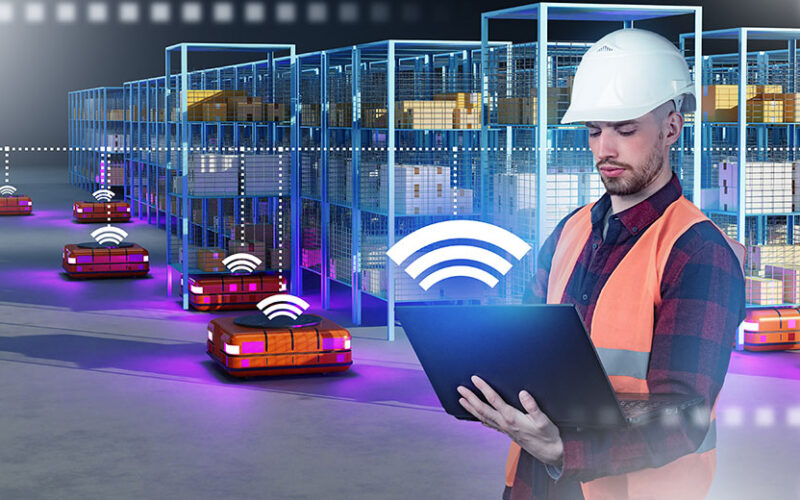
A quiet crisis has been simmering on the warehouse floor in the fast-paced world of contemporary logistics. The “heartbeat” issue has become a crucial bottleneck as autonomous robot fleets grow to satisfy the demands of international e-commerce. A split-second drop in connectivity is more than just a slight lag when hundreds of Autonomous Mobile Robots (AMRs) are navigating aisles at 30 mph; it’s a safety emergency. Conventional Wi-Fi is turning out to be the weak link in the automation chain because it was created for office environments and stationary computers.
The Reasons Wi-Fi Is Reaching a Limit
The problem lies in the way Wi-Fi manages mobility. High-speed cars traveling through “metal forests” of industrial shelves were never meant to be supported by traditional Wi-Fi. When a robot shifts from one access point’s range to another, there is frequently a brief pause called a “handover.”
You wouldn’t notice it at home or at work. However, if a robot needs a continuous “heartbeat” signal to demonstrate that it is functioning securely, missing even two beats results in the system shutting down. A halted machine becomes a high-speed barrier for the remainder of the fleet, creating a chaotic “dead robot” scenario that could result in crashes and destroyed merchandise.
A Network Designed for Speed: The Private 5G Solution
Industry titans Celona and Digi International have partnered to replace erratic Wi-Fi with Private 5G in order to address this. They are offering a level of dependability that Wi-Fi just cannot match by establishing a dedicated cellular “bubble” inside the warehouse.
In contrast to Wi-Fi, 5G was designed with high-speed handoffs in mind. When a robot accelerates across the floor, the link is maintained. Additionally, a large warehouse that might have needed 100 Wi-Fi radios can now be covered by just five or ten 5G nodes since 5G signals penetrate metal and concrete considerably more effectively. This increases the overall network capacity while significantly simplifying the architecture.
The New Business Model: Robots-as-a-Service (RaaS)
The most significant shift in how this technology is offered could arrive by 2026.
The majority of warehouse managers specialize in logistics rather than 5G networking. Celona and Digi are stepping up, offering Robots-as-a-Service (RaaS) to meet this demand.
Now, companies can opt for a managed service, avoiding the hefty initial outlay for complex networking and technology. They get the robots, the 5G gateways, and a central dashboard for real-time fleet monitoring, all for a predictable monthly fee. This “plug-and-play” approach allows smaller retailers to quickly ramp up their automation, eliminating the need for a large team of internal network engineers.
Safety, above all else.
The move to private 5G is ultimately more about safety than it is about efficiency.
The connection is the only thing keeping a tragedy from happening in a busy facility where people and high-speed robots share aisles.
By ensuring a constant, ultra-low-latency heartbeat for every machine, Private 5G is finally clearing the path for the truly “autonomous” warehouse. By 2030, logistics managers will need to consider how quickly they can modernise their networks rather than whether they should.