The evaluation fee is paid. The account is set up. The clock is not ticking — because Breakout Prop doesn’t have one. And yet somehow, thousands of traders still manage to fail their evaluation not because their strategy doesn’t work, but because of entirely preventable mistakes.
The gap between a trader who passes first time and one who burns through two or three evaluation attempts before getting funded isn’t usually skill. It’s approach. It’s the difference between treating the evaluation like a live funded account from day one versus treating it like a competition to be won as fast as possible.
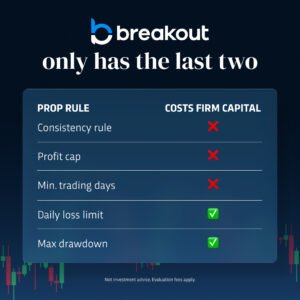
Breakout Prop has built one of the most straightforward and trader-friendly evaluation structures in the crypto prop trading space. No time limits. A clear profit target. Defined drawdown rules. Pass, and you trade up to $200,000 of the firm’s capital and keep up to 90% of what you make. The path is clear. Here’s exactly how to walk it successfully.
Understand What the Evaluation Is Actually Testing
Before any strategy discussion, this is the most important reframe you can make: the Breakout Prop evaluation is not a profit-maximisation challenge. It is a risk management demonstration.
The profit target is the finish line, yes. But what the evaluation is really measuring is whether you can achieve that target without letting your drawdown spiral. Any trader can hit a profit target if they take enough risk. What Breakout — and every serious prop firm — wants to see is whether you can hit that target while keeping losses controlled and consistent. That’s the behaviour of a professional trader. That’s what gets funded.
Every decision you make during the evaluation should be filtered through one question: does this bring me closer to the profit target in a way that keeps my drawdown safely within limits? If the answer is yes, proceed. If the answer involves hoping a losing trade comes back, adding to a position that’s going against you, or trading a size that makes a single loss meaningful relative to your drawdown limit — stop.
The traders who pass first time are almost always the ones who internalise this distinction before they place their first trade.
Step 1: Know the Rules Inside Out Before You Trade a Single Contract
This sounds obvious. It’s astonishing how many traders don’t do it thoroughly.
Breakout Prop’s evaluation rules are clearly defined. The profit target. The maximum daily drawdown. The overall drawdown limit. Whether it’s a 1-step or 2-step evaluation. How drawdown is calculated — whether it’s based on your starting balance, your peak equity, or your current balance. These details matter enormously and affect your trading decisions in ways that only become apparent mid-evaluation if you haven’t planned for them.
Read the evaluation rules line by line before you open a single position. Then read them again. If anything is ambiguous, reach out to Breakout’s support team on WhatsApp before you start — not after you’ve taken a trade you’re unsure about.
Knowing the rules completely allows you to build your trading around them rather than discovering mid-evaluation that your approach conflicts with a rule you didn’t fully understand. This single habit eliminates a meaningful proportion of evaluation failures.

Step 2: Set Your Own Limits Tighter Than the Firm’s
This is one of the most powerful strategies experienced funded traders use — and one of the least discussed.
Breakout’s drawdown limits define the absolute boundaries of the evaluation. Your personal limits should sit comfortably inside those boundaries, acting as an early warning system that keeps you well away from the point of no return.
If Breakout’s daily drawdown limit is 5%, set your personal daily loss limit at 2.5%. The moment you hit your personal limit, you stop trading for the day — no exceptions, no “one more trade to make it back.” If Breakout’s overall drawdown limit is 10%, mentally treat 7% as your ceiling and stop to reassess before you get anywhere near the official limit.
This approach does something psychologically powerful: it removes the sensation of trading close to the edge. When you’re within your personal limits, the official firm limits feel far away and irrelevant — because they are. You’re not white-knuckling through the end of the day hoping your last trade doesn’t wipe the evaluation. You’ve already protected yourself before it became an issue.
Risk management is not about following rules — it’s about building habits that make catastrophic outcomes structurally impossible. Tighter personal limits are the most direct way to do that.
Step 3: Trade Your Actual Strategy — Not an Evaluation Strategy
Here is where a lot of traders go wrong, especially on a first attempt.
They have a strategy they’ve used successfully for months — backtested, refined, with a clear edge in the market. Then the evaluation starts and they abandon it. They start taking trades they wouldn’t normally take because the profit target feels urgent. They hold positions longer than they should because the gain looks close. They switch timeframes, change their setup criteria, or start trading assets they don’t normally follow because something looks “too good to miss.”
Every one of these behaviours undermines the evaluation. The strategy that got you here is the strategy that will pass you through. An evaluation under live market conditions is not the time to experiment, adapt, or improvise. It is the time to execute what you already know works with the same discipline you’d apply to a fully funded account.
If your strategy works on a $10,000 personal account, it will work on a $25,000 or $100,000 evaluation account — provided you scale your position sizes correctly and keep your risk per trade consistent. That’s the only adjustment that needs to happen. Everything else stays exactly the same.
Step 4: Size Your Positions for the Account, Not for Speed
Position sizing is where many technically competent traders fail evaluations. The logic goes like this: the profit target feels like a lot, the drawdown limit feels tight, so they increase their position size to reach the target faster. This is the exact opposite of the correct approach.
Larger positions mean larger losses when trades go against you — and trades will go against you, because that is the nature of trading. A string of three normal losses at an inflated position size can take a meaningful chunk out of your drawdown buffer and shift the entire emotional dynamic of the evaluation from calm and methodical to tense and reactive.
The right approach is to size positions so that a single losing trade — even three or four consecutive losing trades — is well within your planned daily loss limit. If your strategy has a realistic win rate of 55% and an average risk-reward of 1:2, the maths work in your favour over enough trades regardless of position size. You do not need to accelerate by taking more risk. You need to let the edge play out without interference.
A helpful rule of thumb: risk no more than 1% of your evaluation account per trade. At this level, even a losing streak of five consecutive trades — which would be an unusual run for any decent strategy — only costs 5% of the account. You remain well within drawdown limits and can continue executing your plan without panic.
Step 5: Take Advantage of No Time Limits — Use Patience as a Tool
One of Breakout Prop’s most trader-friendly features is the complete absence of time limits on the evaluation. There is no deadline by which you must hit your profit target. Your evaluation stays active until you either pass or breach a drawdown limit.
Most traders intellectually understand this. Far fewer actually trade accordingly.
When there’s no time limit, patience becomes a legitimate and powerful competitive advantage. You do not need to take every possible trade. You do not need to trade every session. You do not need to force setups on days when the market isn’t giving you what your strategy requires.
Waiting for high-probability setups — the ones that genuinely match your criteria with clarity, not the ones you’ve talked yourself into — is not laziness. It is discipline. And discipline in a no-time-limit evaluation is directly rewarded. The traders who take 20 well-selected trades over six weeks consistently outperform the traders who take 80 trades in two weeks, because selectivity improves average quality and reduces the frequency of the emotional, impulsive trades that cause drawdown.
Give yourself permission to do nothing on days when the market isn’t cooperating. Your evaluation will still be there tomorrow. A great setup will come. Trading patience is not a passive trait — it is an active, deliberate choice that directly improves outcomes.
Step 6: Manage the Psychology — The Evaluation Is Not Personal
The emotional component of a prop firm evaluation is underestimated by almost every trader until they’re sitting in the middle of one.
Even when the stakes are objectively manageable — a one-time evaluation fee, a clearly defined set of rules, no time pressure — the psychological weight of trading “on assessment” changes behaviour in subtle and damaging ways. Traders become hesitant when they should act. They hold losing trades longer than they would normally because cutting the loss feels like admitting failure. They take profits too early on winning trades because “locking it in” feels safer. They check their P&L constantly instead of focusing on whether their process is correct.
The antidote to evaluation psychology is to focus entirely on process rather than outcome. Before every trading session, ask: am I following my strategy? Am I sizing correctly? Am I respecting my personal loss limits? These are the only questions that matter during the session. The profit target takes care of itself if the process is consistently correct.
After each session, review what you did — not just what the market did. Trading journals are not optional during an evaluation. They are the mechanism by which you catch behavioural drift before it becomes account-threatening.
The Most Common Reasons Traders Fail the Evaluation — And How to Avoid Them
Overtrading on a bad day — One losing session becomes an attempt to “make it back” by taking more trades at higher risk. Personal daily loss limits prevent this entirely.
Position sizing creep — Gradually increasing position sizes as the profit target gets closer, which increases risk at exactly the wrong moment. Commit to a fixed position size and don’t adjust it during the evaluation.
Trading unfamiliar assets — The Breakout Terminal supports over 100 cryptocurrencies. More choice is not an invitation to explore. Trade the assets you know and understand. Unfamiliar market behaviour during an evaluation is a liability, not an opportunity.
Ignoring the rules — Assuming you remember the drawdown calculation correctly without checking. Re-read the rules at the start of the evaluation and refer back to them if anything feels uncertain.
Treating it like gambling — Taking one large, high-conviction position to hit the target in a single trade. This approach fails more often than it succeeds, and when it fails, it often ends the evaluation. Consistent small wins are always the correct approach.
Final Thought: The Evaluation Is Designed to Be Passable
This is worth saying clearly. Breakout Prop’s evaluation is not designed to trap traders. It is not structured to make passing impossible or to extract evaluation fees as a primary revenue model. The firm makes its money when funded traders make profits — which means the evaluation exists to identify traders with genuine discipline and a real edge, not to create an obstacle course that rewards luck over skill.
If you have a strategy that works, if you manage your risk correctly, if you trade what you know and resist the impulse to force it — you will pass. The no-time-limit structure, the clear rules, and the professional trading infrastructure Breakout provides through Kraken’s backing are all designed to give capable traders every reasonable opportunity to succeed.
The evaluation is the door. What you’ve already built as a trader is the key. Use it correctly.
Start Your Breakout Prop Evaluation