

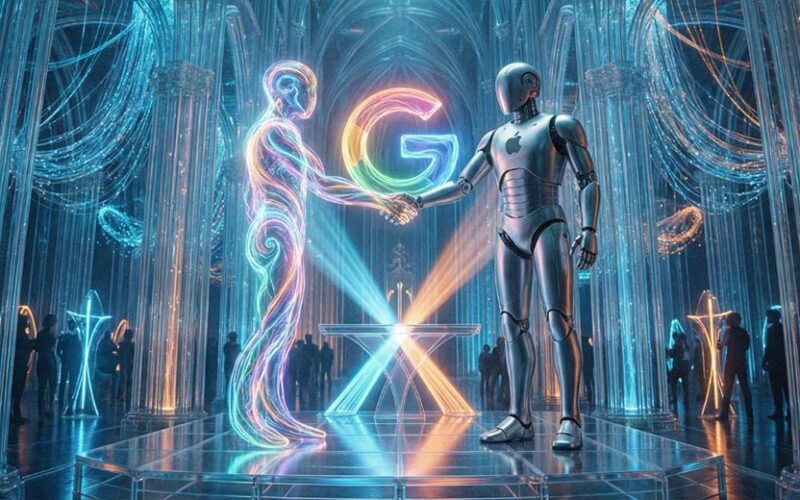
High-stakes relationships in the tech industry frequently resemble fast-paced romantic relationships that ultimately result in a difficult and costly divorce. One of the most significant “marriages of convenience” in ten years is currently in its honeymoon stage: Apple and Google are collaborating to bring Gemini to the iPhone.
Those who have followed these titans for decades notice a recurring pattern, and the conclusion typically involves Apple keeping the house while the partner is left wondering what happened to the furniture, even as the headlines center on the significant upgrade to Siri.
Why Gemini is Apple’s Only Option (For Now): Apple was late to the AI party, which is a problem that even its enormous cash reserves couldn’t address.
Despite promoting “Apple Intelligence” as a privacy-focused, on-device solution, mobile CPUs struggle to handle the “heavy lifting” of next-generation AI. Apple required a “frontier model” that wouldn’t crash when it reached two billion devices.
Infrastructure: The fiber, data centers, and specialized TPU (Tensor Processing Unit) clusters required for global scale are all owned by Google.
Multimodality: Gemini is more than just a chatbot; if Siri is to go beyond a basic voice command tool, it must be able to comprehend video, photos, and workplace data.
The “Apple Partnership Trap”
The corpses of businesses that believed an agreement with Apple would be their ticket to the major leagues are scattered throughout history. A recurrent trend can be seen in everything from the 2014 IBM MobileFirst alliance to the current spat with Goldman Sachs on the Apple Card: Apple collaborates until it can copy.
The Bridge is the first phase. Apple fills a void in its own ecosystem by utilizing a partner’s technology.
The Poach is the second phase. In order to replicate the partner’s capabilities, Apple starts creating internal teams (such as its “Ajax” models).
The third phase is the divorce. When Apple’s internal technology is “good enough,” the partner is either eliminated completely or reduced to a secondary extension.
Google is supplying its largest rival with the intellectual engine through the integration of Gemini. Google plays a risky game by assisting Apple in maintaining the supremacy of the iPhone, which is detrimental to Google’s own Android platform.
Vulnerabilities Shared by Apple and Microsoft
It’s interesting to note that Apple and Microsoft are in a similar situation right now: neither company owns the underlying AI stack on which they are placing their bets.
Microsoft has a close relationship with OpenAI.
Apple and Google are now connected.
Both businesses are “Alpha” entities that require complete control. It is a public admission that their internal R&D was unable to keep up with the generative AI revolution while they relied on third-party AI.
The Long-Term Risk and the Strategic Masterstroke
This is an excellent short-term move for Apple. It essentially eliminates the AI advantage that Google’s Pixel and Samsung’s Galaxy devices previously possessed.
The long-term danger, though, is “lobotomization.” Apple’s “intelligence” may be abruptly curtailed if the partnership breaks down over revenue-sharing or if Google chooses to retain its best features for Android. Although user data is protected by Apple’s Private Cloud Compute, the “brain” still resides in Mountain View.
Final Prognosis: A Difficult Split
If history is our guide, Apple will eventually try to shrink Gemini’s footprint in favor of its own models. But Google is more resilient than previous partners like Intel or IBM. Google owns the “search economy” that fuels billions in Apple’s service revenue.
This makes the eventual divorce not just a split, but a potential legal and economic war. For now, Apple has the tools it needs to keep the iPhone relevant, but Google may find it has made a “deal with the devil”—feeding the very beast that seeks to eventually replace it.
Product of the Week: Artlist.io
On a lighter note, if you are a creator, Artlist.io is a game-changer. I’ve been using it for months to source high-quality, royalty-free music and SFX. It’s one of the few subscription services that actually feels like it’s worth more than it costs—a rare feat in today’s “subscription fatigue” economy.